
Disneynature’s newest movie, Chimpanzee, is a documentary masterpiece for all ages. It’s a truly original film that stands out in a multiplex of lookalikes, copies, remakes, and sequels. And Chimpanzee’s cinematography is amazing, the simple beauty of the jungles and the animals stands in contrast to so many of today’s movies all tricked out with 3D gimmicks and computer-generated special effects.
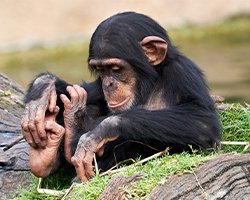
Filmmakers spent four years “embedded” in the lush rainforest of Ivory Coast’s Tai National Park to make the movie, which follows the life of “Oscar,” a predictably adorable young chimp. Oscar learns how to use rocks to open nuts (apparently harder than it looks) and use sticks to go “fishing” for army ants (apparently a real delicacy to chimpanzee foodies). There’s a turf war with a rival community for control over a valuable nut grove. And, this being a Disney movie, Oscar loses his mother to a leopard around the beginning of the third reel. (It’s handled sensitively. There’s nothing to terrify children or grandchildren in the audience.) Losing his mother poses a real threat to Oscar’s life, until, remarkably, he’s “adopted” by Freddy, the community’s alpha male. The film is narrated by Tim Allen, whom even the youngest viewers will recognize as the voice of “Buzz Lightyear” from Disney/Pixar’s mega-successful Toy Story series.
Primatologists have suspected that chimpanzees like Freddy might altruistically adopt orphaned young in their group. But this is the first example of such behavior actually caught on film. (There’s no word on whether Freddy “taxed” the rest of the community for the expenses of caring for Oscar, or whether “tax avoidance” is part of their natural behavior!)
Disney has announced that they are donating a portion of Chimpanzee’s opening-weekend ticket sales to the Jane Goodall Institute for the “See Chimpanzee, Save Chimpanzee” program to protect habitats. Disney will donate 20 cents for every ticket sold, with a minimum donation of $100,000. (The movie grossed $10.2 million over its opening weekend, the highest opening gross in history for any nature documentary.) So, and here at last we come to the tax question of the day, does that mean that if you were one of the first to see it, you can deduct part of your ticket?
Unfortunately, no, that’s not how it works. You got your “money’s worth” from the movie itself, although Disneynature can certainly deduct the contribution on its return. It’s like buying a ticket to a college football game. The college itself may be a not-for-profit organization but buying a ticket isn’t a “donation” because you get something of value in exchange. (Some colleges let you make donations in exchange for the right to buy season tickets, in those cases, the IRS treats that “right” as being worth 20% of the donation amount and lets you deduct the remaining 80%.)
Deductions for charitable contributions are a mainstay of the tax code. Charitable contributions let you do well for society while you do well for yourself, which of course is something we want to help with, too! We can help you maximize deductions for gifts of used clothing and household accessories. We can help you plan for bigger gifts of cash, cars or boats, art or antiques, appreciated securities, real estate, and even life insurance. And don’t forget, we’re here for the rest of your “community,” too!
Donna Bordeaux, CPA with Calculated Moves
Creativity and CPAs don’t generally go together. Most people think of CPAs as nerdy accountants who can’t talk with people. Well, it’s time to break that stereotype. Lively, friendly, and knowledgeable can be a part of your relationship with your CPA as demonstrated by Donna and Chad Bordeaux. They have over 50 years of combined experience as entrepreneurial CPAs. They’ve owned businesses and helped business owners exceed their wildest dreams. They have been able to help businesses earn many times more profit than the average business in the same industry and are passionate about helping industries that help families build great memories.